Michael Medved, who is no shrinking violet, is out with an op-ed piece claiming that the Founders intended a Christian America, not a secular one. Although this would have been obvious to anyone born prior to 1900, his historical review is instructive for us who live in this benighted latter day:
In fact, the same Congress that approved the First Amendment gave a clear indication of the way they understood its language when, less than 24 hours after adopting the fateful wording, they passed the following Resolution: “Resolved, that a joint committee of both Houses be directed to wait upon the President of the United States, to request that he would recommend to the people of the United States a day of public thanksgiving and prayer, to be observed by acknowledging, with grateful hearts, the many signal favors of Almighty God, especially by affording them an opportunity peaceable to establish a Constitution of government for their safety and happiness.” It never occurred to this first Congress in 1789 that their call for a government sponsored day of “thanksgiving and prayer” would conflict with the prohibition they had just adopted prohibiting “an establishment of religion.” Not until the infamous Everson decision of 1947 did the Supreme Court create the doctrine of a “wall of separation between church and state,” quoting (out of context) from an 1802 letter from Thomas Jefferson to the Danbury Baptist Association. President Jefferson created the image of the wall in order to reassure the Baptists that government would never interfere with their religious life, but he never suggested that religion would have no role in government. In 1803, in fact, Jefferson recommended to Congress the approval of a treaty that provided government funds to support a Catholic priest in ministering to the Kaskaskia Indians.
Three times he signed extensions of another measure described as “An Act regulating the grants of land appropriated for Military services and for the Society of the United Brethren for propagating the Gospel among the Heathen.” Jefferson also participated every week in Christian church services in the Capitol Building in Washington DC; until 1866, in fact, the Capitol hosted worship every Sunday and, intermittently, conducted a Sunday school. No one challenged these 71 years of Christian prayer at the very seat of federal power: given the founders' endorsement of the positive role of organized faith, it hardly inspired controversy to convene worship at the Capitol. In fact, at the time of the first Continental Congress, nine of the thirteen original colonies had “established churches” – meaning that they each supported an official denomination, even to the point of using public money for church construction and maintenance. These religious establishments – clearly in contradiction to the idea of a “secular government” – continued in three states long after the adoption of the First Amendment. Connecticut disestablished its favored Congregational Church only in 1818, New Hampshire in 1819, and Massachusetts in 1833.
Amazingly enough, these established churches flourished for nearly fifty years under the constitution despite the First Amendment’s famous insistence that “Congress shall make no law respecting an establishment of religion.”
Read the whole thing (and comments if you can tolerate it) here.
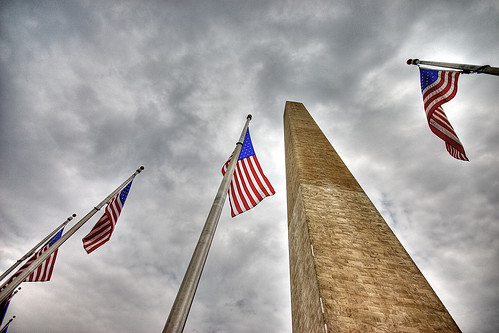
Photo by Joey Gannon; some rights reserved.